
Sorrow's Treshold
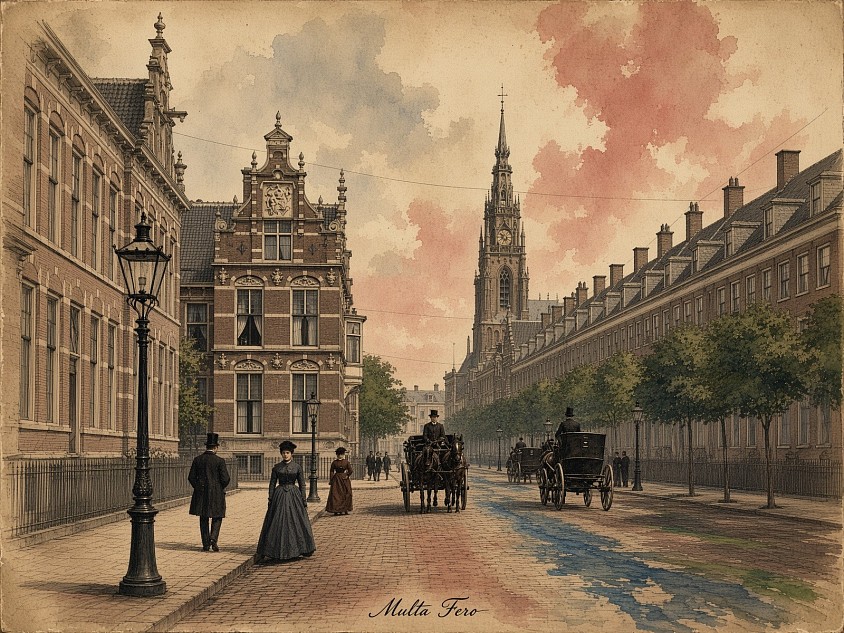
The Hague
1882, The Hague
When the Etten door sealed shut on Christmas Day 1881, the judgment fell with the weight of a stone, and by the first pale light of January 1882 Vincent van Gogh already claimed the bare rooms at 138 Schenkweg, where a south window twice the ordinary measure poured its severe, impartial fire across scrubbed boards still scented with lye.
He arrived marked by the ashes of rupture—the father’s rigid face, the festive table turned tribunal, the command that severed the last thread of respectability. The winter plains stretched the colour of ancient lead; every ditch a black stroke of condemnation. Theo’s letter from Paris arrived measured and pained: settling in The Hague was wise, yet the manner of leaving was childish and shameless. Vincent answered point by point, refusing the Jesuitisms of blood, declaring deliverance rather than regret. When a man is told to depart, the path becomes clear though it lead into wilderness.
Anton Mauve met him on the platform, lent a hundred guilders, and began the lessons—watercolour first, the slow accumulation of tone as sorrow accumulates in a life. Cattle in the polder, air that must itself be painted. Yet Vincent hungered more for the figure, the weight of labour written in shoulders and hands. Shared nervous blood soon thickened into friction. In the wet streets near the Geest he found her: Clasina Maria Hoornik, called Sien, thirty-two, pregnant, deserted, walking the winter pavement with her five-year-old daughter. He offered regular if meagre pay, a stove, bread, and the refusal to abandon. She answered that she would stay, no matter how poor. That night the charcoal whispered across paper as he drew her; the household he had chosen breathed beyond the lamp’s yellow circle.
Uncle Cor’s commission for twelve Hague views brought the first real coin. Models arrived—seamstresses, orphan men, faces marked by the same hunger. But Mauve could not approve the life shared with a former prostitute. On the dunes the rupture came clean: “You have a vicious character.” Vincent walked home alone, sand gritting between his teeth, the sea roaring its indifference. He would not retract the declaration “I am an artist,” meaning one who seeks without end. Nor would he cast Sien back into the street.
In April he drew her hunched and naked, the body a compact of desolation against a stark ground—Sorrow, the best figure he had yet made, something straight from his own heart. Letters to Theo grew longer, fiercer: is it more manly to desert a woman or to concern oneself with one who has been deserted? On est sûr de périr à part; on ne se sauve qu’ensemble. June delivered him to the municipal hospital, carbolic and thin mattresses; across the corridor Breitner raised a silent hand. On the second of July Sien bore a son named Willem amid forceps and chloroform. Vincent stood in the ward, sunlight on new green beyond the window, and felt a door long closed forced ajar by the simple fact of beginning.
They moved to larger rooms at 136 Schenkweg. He hung Rembrandt’s etching of women by a cradle above the iron bed. In late August, on a day of storm at Scheveningen, the wind drove sand into his hair, eyes, and mouth until he could scarcely stand; those same grains remain embedded in the paint of Beach at Scheveningen in Stormy Weather. The waves were the colour of dirty dishwater, yet the heavy impasto held the weather itself. That night, beneath the paraffin flame, he wrote the ambition that would outlast every judgment: to show by his work what such a nobody has in his heart—deep anguish rather than sentiment, so that people might one day say of him, that man feels deeply, that man feels keenly.
The year closed with a life of his own fierce making—contested by family, condemned by the respectable, sustained by a brother’s gold and a woman’s quiet endurance. The sand from the storm and the charcoal lines of Sorrow remained as permanent marks. The great south window continued to fall, impartial and uncompromising, upon a seeker who had refused to perish.
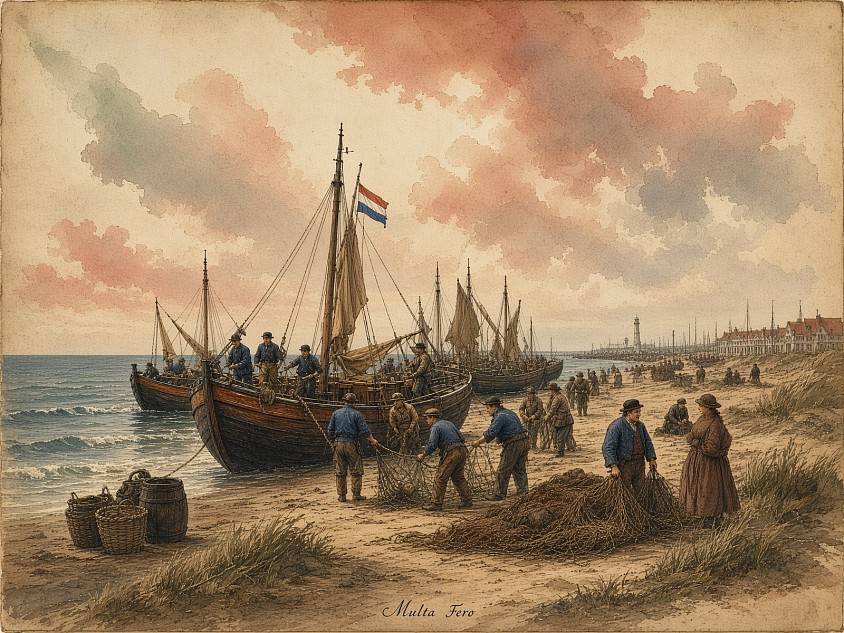
Scheveningen Fishing Boats and Fishers
